
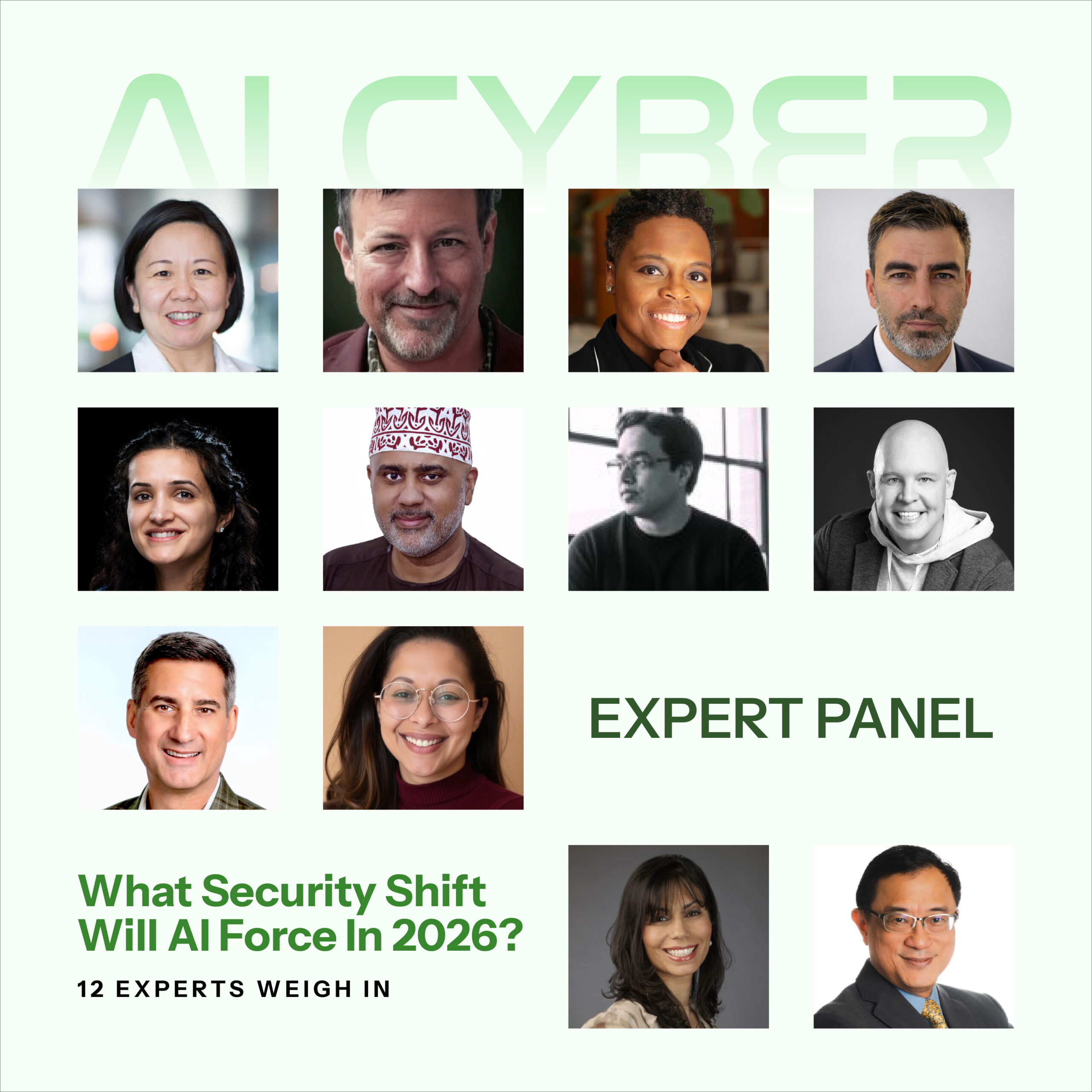
As AI reshapes the threat landscape and transforms how organizations operate, security leaders face a fundamental question: what changes when autonomous systems move faster than human oversight? We asked 12 industry experts to identify the single most important security shift AI will force in 2026. Their answers converge on a striking theme: the era of reactive security is ending. What comes next will be defined by governance, continuous assurance, and the ability to prove safe behavior in real time.
The End Of Reactive Security
The traditional security model, detect threats, investigate, respond, was built for a world where humans set the pace. That world is disappearing. When autonomous agents can act faster than analysts can review alerts, the entire paradigm breaks down.
| “AI will force security to move from detecting threats after they occur to controlling AI behavior in real time with enforceable guardrails and proof of compliance. The winners in 2026 will be the teams that can govern what AI is allowed to do, not just respond when it goes wrong.”
Saurav Banerjee, AI Security Lead, Samsung |
| “AI will force organizations to accept that preventing compromise is no longer realistic when facing autonomous agents that operate faster than humans can respond. Security will shift from perimeter defense to assuming threats are already inside, requiring autonomous monitoring and response systems that work at the same pace to detect and contain attacks as they unfold.”
Mudita Khurana, Staff Security Engineer |
From Static Controls To Continuous Assurance
Annual audits and point-in-time compliance checks were designed for systems that changed slowly. AI systems change constantly. The new requirement: prove your systems are behaving securely right now, not that they passed a test six months ago.
| “In 2026, AI will force a shift from static controls to continuous assurance, as autonomous agents act faster than human oversight can keep pace. Security will center on governing behavior in real time, not just preventing access.”
Nia Luckey, Lead of Governance & Monitoring, AT&T |
| “AI will need a move from perimeter- and reaction-based security to continuous assurance, behavioral validation, and zero-trust execution environments. In 2026, the issue will not be: ‘Is this system secure?’ but rather, ‘Is this system behaving securely right now, and can we prove it?'”
Chuck Brooks, Adjunct Professor, Georgetown University |
| “AI will force security to shift from reactive detection to real-time behavioral constraint, where systems are governed by enforced limits rather than alerts. In 2026, resilience will be defined by how effectively autonomy is bounded, not how quickly breaches are discovered.”
Looi Teck Kheong, Global AI Ambassador, President, Singapore Chapter, Global Council for Responsible AI |
The Rise Of Decision Governance
Access control asks: who can enter the system? Decision governance asks: who can delegate authority, under what policies, and with what stop conditions? As AI systems make more autonomous decisions, the latter question becomes the one that matters.
| “AI will force security to shift from controls to decision governance: who can delegate authority, under what policies, and with what stop conditions. Assurance will move from ‘we deployed tools’ to ‘we can prove execution stayed within guardrails.’ Metrics will matter only if they trigger slow/stop/escalate decisions. Feedback loops must update policy, not prompts.”
Codrut Andrei, Director of Product Security, The Access Group |
| “AI will force security leaders to move from control-based assurance to decision-based assurance. If leaders can’t govern how decisions are made, validated, and corrected, they can’t secure an AI-driven enterprise.”
Tia Hopkins, Chief Cyber Resilience Officer and Field CISO, eSentire |
| “If leaders can’t govern how decisions are made, validated, and corrected, they can’t secure an AI-driven enterprise.“ |
When Decisions Have Physical Consequences
The stakes escalate dramatically when AI decisions affect physical systems. In operational technology environments, an ungoverned decision is not just a data breach. It can cause real-world harm.
| “In 2026, AI will redefine the attack surface in OT (Operational Technology) from systems to decisions. As AI influences industrial control logic, safety responses, and autonomous actions, security must validate provenance, authority, and intent. In cyber-physical environments, an ungoverned decision can have real-world impact.”
Dd Budiharto, CSO, Microsoft |
The Shadow AI Reckoning
Prohibition has failed. With shadow AI usage rates approaching near-universal adoption, organizations face a binary choice: build governance around the tools employees are already using, or accept that control has been lost entirely.
| “Security will shift from prohibition to visibility. The 96% shadow AI usage rate makes ban policies theater. 2026 is when organizations either build governance around tools employees already use or accept they’ve lost control entirely.”
Rob T. Lee, Chief AI Officer, Chief of Research, SANS Institute |
| “The 96% shadow AI usage rate makes ban policies theater.“ |
Technology Is No Longer The Weakest Link
For decades, security focused on hardening systems. But as AI becomes embedded in critical infrastructure, the failure points shift. Human judgment, information sharing, and governance become the new vulnerabilities.
| “Security will shift from protecting systems to governing behaviour across data, algorithms, and people. Technology will not be the weakest link; human judgement, information sharing, and governance will be. Those who treat AI as critical infrastructure, independently tested, red-teamed, and accountable, will move faster and safer.”
Abdul-Hakeem Ajijola, Chair, African Union Cybersecurity Experts Group |
The Identity Challenge No One Is Talking About
While much attention focuses on AI threats and AI defenses, one critical operational challenge is being overlooked: identity and access management for AI agents themselves. IAM teams unprepared for this shift may become the bottleneck to enterprise AI adoption.
| “As organizations adopt agentic AI, this will very likely put an increased load on IAM teams who will need to manage full lifecycle agent identities but at increased scale and number. IAM teams who aren’t now preparing process and automation for this will likely find themselves in the way to effective AI adoption.”
Ian Schneller, Retired 3x Large Enterprise CISO |
Speed Changes Everything
AI does not just introduce new attack vectors. It compresses timelines. Vulnerabilities that once offered days or weeks of response time now offer minutes. This acceleration forces security back to fundamentals: patch management, training, and embedding security earlier in strategic decisions.
| “AI will force cybersecurity leaders and organizations to rethink their Training & Awareness programs and accelerate their patch management processes. The speed at which an adversary can exploit a vulnerability (using AI) and turn it into a critical risk is eliminating our ability to delay addressing vulnerabilities regardless of the risk tier. Now more than ever, Security will also need to be embedded earlier as a core voice in strategic decisions and understand the overall impact of being compromised. It’s imperative that we understand the financial impact on the business to build infrastructure that is resilient for the future.”
Monique Hart, Vice President of Information Security | CISO, Piedmont |
Across industries and geographies, these 12 experts converge on a single conclusion: 2026 marks the end of security as a reactive discipline. The organizations that thrive will be those that can govern AI behavior in real time, prove compliance continuously, and make decisions at machine speed. Detection is no longer enough. The future belongs to those who can constrain, validate, and demonstrate safe behavior before harm occurs.
* *