
– By Dr. Dustin Sachs.
The average SOC analyst makes more decisions in a single shift than most people do in a week, and the stakes are existential. Every blinking alert, every incomplete data trail, every ambiguous log entry demands judgment under pressure. And yet, the very tools meant to help—dashboards, threat feeds, SIEMs—often flood defenders with so much information that they become paralyzed, fatigued, or worse, desensitized. This is the real threat behind cognitive overload in cybersecurity.
But what if AI didn’t just accelerate detection, but actively reduced mental load? What if it could help us think better, not just faster? AI, when designed with behavioral insights in mind, can become not just an automation engine but a cognitive ally (Kim, Kim, & Lee, 2024).
Understanding Cognitive Overload in Cyber Contexts
Cognitive overload occurs when the volume and complexity of information exceeds a person’s working memory capacity. In cybersecurity, this happens daily. Analysts must process thousands of alerts, each with its own potential consequence, often in noisy environments under time pressure.
Drawing from Daniel Kahneman’s System 1/System 2 thinking, most analysts oscillate between intuitive snap decisions and laborious, analytical reasoning. Under stress, they revert to mental shortcuts, increasing the risk of oversight (Kim & Kim, 2024).
A 2025 survey from Radiant Security found that 70% of SOC analysts suffer from burnout, and 65% are actively considering a job change. The primary driver is alert fatigue caused by the flood of false positives and manual triage demands. This constant barrage of low-value alerts overwhelms analysts’ cognitive capacity, leading to mental exhaustion, slower response times, and decreased job satisfaction (Radiant Security, 2025).
Additionally, cognitive overload contributes to higher error rates, inconsistent documentation, and a breakdown in team coordination (Cau & Spano, 2024).
When AI Makes It Worse
Despite the growing enthusiasm surrounding artificial intelligence in cybersecurity, the reality is more complex. Not all AI implementations are beneficial—some can actually exacerbate the very problems they were designed to solve.
- Poorly integrated AI systems often produce an overwhelming volume of false positives, bombarding analysts with alerts that require manual triage.
- Opaque, black-box models create trust gaps, forcing analysts to make high-stakes decisions without clear explanations.
- “Alert multiplicity” has become a problem: many AI tools flood SOCs with signals that lack relevance or priority, adding to the noise rather than reducing it (Camacho, 2024).
Instead of cutting through the noise, such AI tools often add to it—leaving analysts frustrated and overwhelmed.
Reframing AI as a Cognitive Augmentation Tool
To realize AI’s true potential, it must be reimagined not as an automated watchdog, but as a cognitive ally. The shift from detection engine to decision support system is not just semantic—it’s strategic. AI must be designed to think with analysts, not for them.
- Intelligent Prioritization – Instead of treating all anomalies equally, advanced systems can learn from historical triage behavior to rank alerts by actionability. This helps analysts focus on meaningful threats (Romanous & Ginger, 2024).
- Natural Language Summarization – AI-powered tools like Microsoft Security Copilot and IBM QRadar condense logs and raw data into digestible executive summaries, enabling faster comprehension (Akhtar & Rawol, 2024).
- Behavioral AI Integration – Systems can adapt to analysts’ work patterns, presenting information in chunked formats to reduce context-switching. Subtle nudges, such as highlighting inconsistencies or recommending secure defaults, improve consistency under stress (Shamoo, 2024).
Strategic Recommendations for Implementation
To maximize impact, organizations should embed AI into cybersecurity workflows using human-centered design principles.
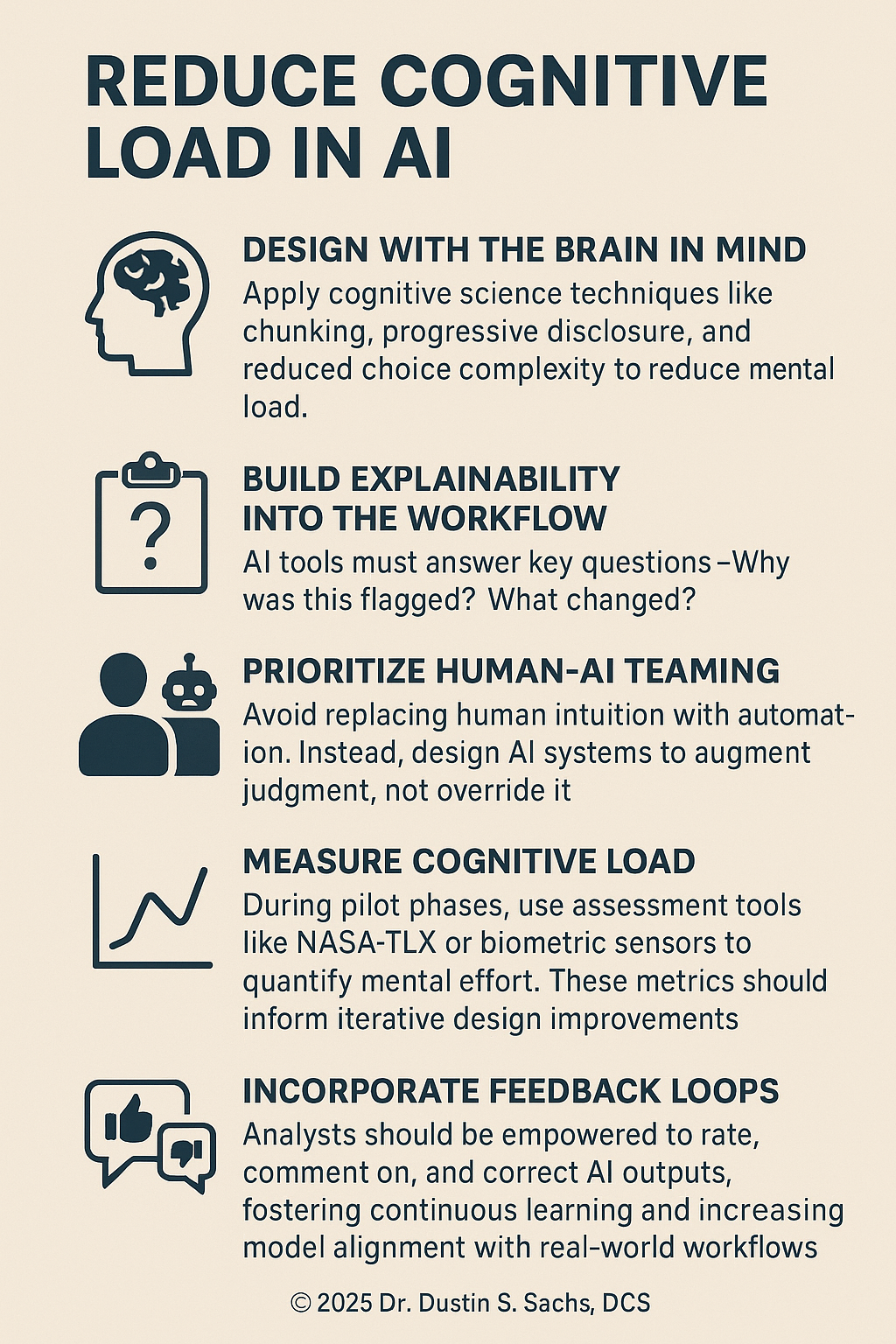
Cybersecurity is ultimately a human endurance sport, demanding sustained attention, resilience under pressure, and rapid decision-making amid uncertainty.
In this high-stakes landscape, AI can become a trusted teammate rather than an overbearing taskmaster. By shifting the narrative from AI as an automation panacea to a strategic cognitive asset, security leaders empower their teams to make better, faster, and more informed decisions.
This reframing fosters an environment where defenders not only keep pace with threats but develop the capacity to adapt, learn, and excel over time.
References
Akhtar, Z. B., & Rawol, A. T. (2024). Enhancing cybersecurity through AI-powered security mechanisms. IT Journal Research and Development. https://doi.org/10.25299/itjrd.2024.16852
Bernard, L., Raina, S., Taylor, B., & Kaza, S. (2021). Minimizing cognitive overload in cybersecurity learning materials: An experimental study using eye-tracking. Lecture Notes in Computer Science, 47–63. https://doi.org/10.1007/978-3-030-80865-5_4
Camacho, N. G. (2024). The role of AI in cybersecurity: Addressing threats in the digital age. Journal of Artificial Intelligence General Science. https://doi.org/10.60087/jaigs.v3i1.75
Cakır, A. M. (2024). AI driven cybersecurity. Human Computer Interaction. https://doi.org/10.62802/jg7gge06
Cau, F. M., & Spano, L. D. (2024). Mitigating Human Errors and Cognitive Bias for Human-AI Synergy in Cybersecurity. In CEUR WORKSHOP PROCEEDINGS (Vol. 3713, pp. 1-8). CEUR-WS. https://iris.unica.it/retrieve/dd555388-5dd2-4bb2-870d-92926d59be04
Folorunso, A., Adewumi, T., Adewa, A., Okonkwo, R., & Olawumi, T. N. (2024). Impact of AI on cybersecurity and security compliance. Global Journal of Engineering and Technology Advances, 21(1). https://doi.org/10.30574/gjeta.2024.21.1.0193
Ilieva, R., & Stoilova, G. (2024). Challenges of AI-driven cybersecurity. 2024 XXXIII International Scientific Conference Electronics (ET). https://doi.org/10.1109/ET63133.2024.10721572
Kim, B. J., Kim, M. J., & Lee, J. (2024). Examining the impact of work overload on cybersecurity behavior. Current Psychology. https://doi.org/10.1007/s12144-024-05692-4
Kim, B. J., & Kim, M. J. (2024). The influence of work overload on cybersecurity behavior. Technology in Society. https://doi.org/10.1016/j.techsoc.2024.102543
Malatji, M., & Tolah, A. (2024). Artificial intelligence (AI) cybersecurity dimensions. AI and Ethics, 1–28. https://doi.org/10.1007/s43681-024-00427-4
Radiant Security. (2025). SOC analysts are burning out. Here’s why—and what to do about it. Radiant Security. https://radiantsecurity.ai/learn/soc-analysts-challenges/
Romanous, E., & Ginger, J. (2024). AI efficiency in cybersecurity: Estimating token consumption. 21st Annual International Conference on Privacy, Security and Trust (PST). https://doi.org/10.1109/PST62714.2024.10788078
Shamoo, Y. (2024). Advances in cybersecurity and AI. World Journal of Advanced Research and Reviews. https://doi.org/10.30574/wjarr.2024.23.2.2603
Siam, A. A., Alazab, M., Awajan, A., & Faruqui, N. (2025). A comprehensive review of AI’s current impact and future prospects in cybersecurity. IEEE Access, 13, 14029–14050. https://doi.org/10.1109/ACCESS.2025.3528114strat