Autonomous AI agents are reshaping how enterprises operate. These systems can execute complex workflows, make decisions, and take action with minimal human oversight. The business case is compelling: faster execution, reduced operational costs, and around-the-clock productivity. Yet for every boardroom conversation about efficiency gains, there is an equally urgent discussion happening in legal, compliance, and security offices across the globe.
The anxiety is justified. Unlike traditional software that follows predetermined paths, autonomous agents reason, adapt, and act in ways that can be difficult to predict or trace. When something goes wrong, the consequences extend far beyond a system error. We are talking about regulatory violations, unauthorized expenditures, security breaches, and legal exposure. Decision-makers are no longer just purchasing technology; they are delegating authority to systems whose “thinking” often remains opaque. Before signing off on any autonomous agent deployment, leaders need clarity on a fundamental question: How do you prove this system will stay within bounds?
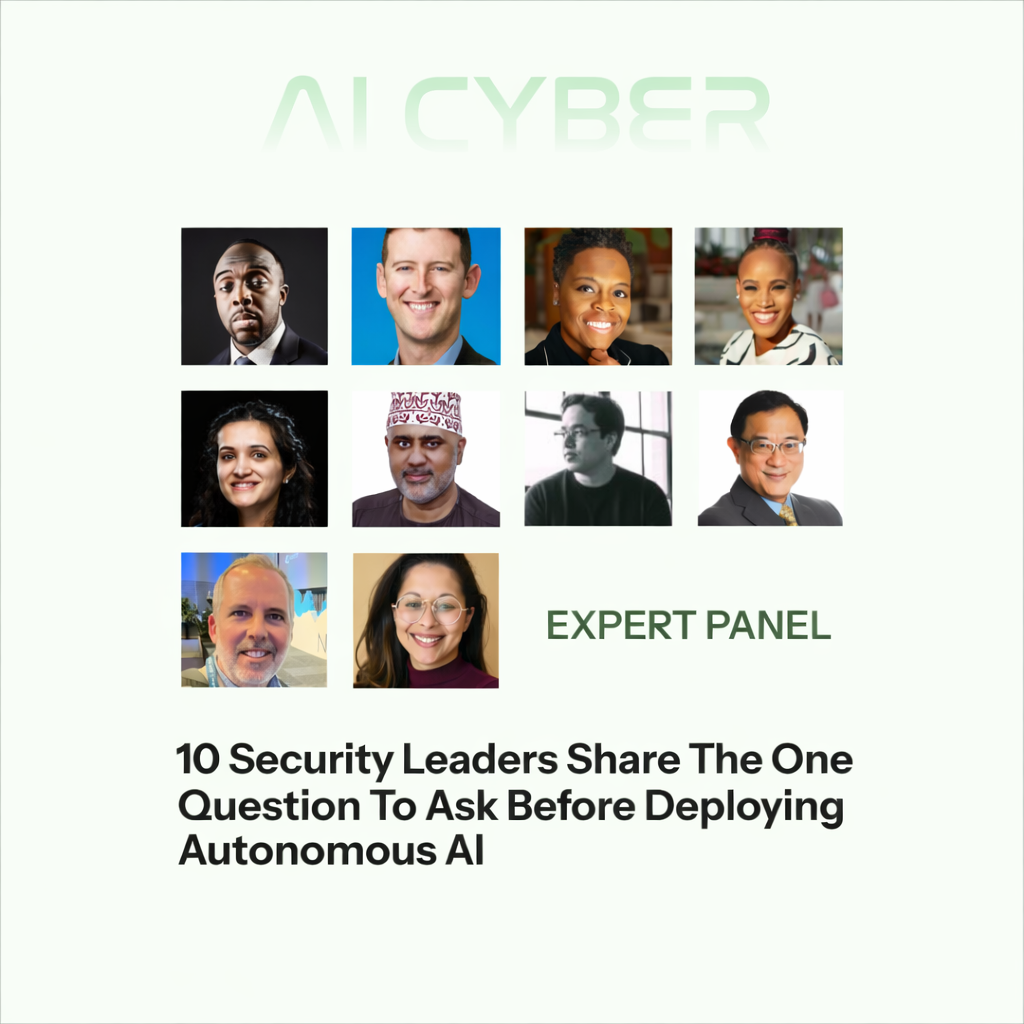
We asked 10 technology and security leaders to share the single most critical assurance question decision-makers should ask vendors before deploying autonomous agents. Their responses converge on one theme: demand proof, not promises.
Enforce It or It Does Not Exist
Saurav Banerjee, AI Security Lead at Samsung, cuts straight to the core: “How do you technically enforce and prove that the agent can never act outside approved policies in real time?” His question demands more than documentation. He wants hard guardrails, continuous runtime policy enforcement, full auditability, rollback control, and independent validation that actually works in production.
This sentiment echoes across the expert panel. Looi Teck Kheong, Global AI Ambassador and President of the Singapore Chapter of the Global Council for Responsible AI, frames it in architectural terms: “The decisive question is: what verifiable, runtime enforcement mechanisms exist to constrain the agent’s actions, not just its design intent?” He argues that true assurance comes from enforcement-by-architecture, not from testing or post-hoc reporting.
The Audit Trail Is Everything
Mudita Khurana, Staff Security Engineer, raises a point that should concern any compliance officer: “Can you provide a complete audit trail of agent decision-making, including actions the agent considered but chose not to take?” Most vendors can tell you what got blocked. Far fewer can show you what the agent wanted to do and which specific constraint stopped it. For agents with production access, she considers this visibility non-negotiable.
Nia Luckey, Lead of Governance and Monitoring at AT&T, reinforces this standard. Decision-makers should seek “verifiable evidence of enforceable guardrails, real-time policy validation, auditable decision logs, and automated kill-switches when security, legal, compliance, or budget thresholds are breached.”
Test It, Then Test It Again
Dan Barahona, Co-Founder of APIsec University, challenges leaders to ask for proof through continuous security testing: “What continuous security testing shows that agents can’t escape policy via prompt injection, tool manipulation, or other AI/API exploit?” Guardrails must be enforced and validated with repeatable tests. If vendors cannot produce logs and test results, it is not a guarantee.
Tia Hopkins, Chief Cyber Resilience Officer and Field CISO at eSentire, frames the vendor conversation with clarity: “Show me how the agent’s decisions are governed, constrained, and auditable end-to-end; not just what it can do.” Decision-makers do not need another promise of accuracy. They need proof that every autonomous action is bounded by explicit security, legal, compliance, and cost controls. That means guardrails, continuous validation, and a clear chain of accountability when the agent adapts or escalates. “If a vendor can’t demonstrate how intent, context, and constraints are enforced in real time,”Hopkins warns, “you’re actually outsourcing risk, when you might think you’re buying autonomy.”
Human Override Is Non-Negotiable
Abdul-Hakeem Ajijola, Chair of the African Union Cybersecurity Experts Group, brings a governance perspective that transcends technical controls: “Prove that humans can always see, stop, and correct what this AI is doing. If decisions cannot be traced, audited, and overridden, the system is unsafe by design.” His observation that resilience fails more from governance inertia than from attackers should give every executive pause.
Brian Fricke, MSVP CISO and Head of Technology Risk at City National Bank of Florida, synthesizes multiple requirements into one comprehensive question. He asks vendors to demonstrate “with independently verifiable controls and logs, that every autonomous action is pre-authorized, continuously constrained, and automatically halted when it violates a formally defined policy, legal, security, or budget boundary.” If vendors cannot show deterministic constraint enforcement plus real-time observability, he concludes, the agent is not governable.
Watch How It Learns
Mari Galloway, CEO, shifts focus to an often-overlooked dimension of autonomous systems: their evolution over time. Decision-makers should ask “how the vendor continuously monitors, governs, and validates agent changes as it learns and reasons toward its goals.” This visibility ensures execution paths remain within guardrails and enables rapid intervention when updates introduce new risks.
Dr. Blake Curtis, Senior Leader of AI Risk Management, Strategy, and Governance at Amazon Web Services, provides a practical framework for the conversation: “What built-in controls stop this agent from doing something unsafe, illegal, non-compliant, or too expensive, such as human-in-the-loop, access limits, spending caps, or kill switches? And what transactional, real-time monitoring of inputs, processing, and outputs detects abnormal or risky behavior early and flags it before harm occurs?”
The Bottom Line
The consensus among these experts is clear. Autonomous agents require a fundamentally different approach to vendor assurance. Traditional security questionnaires and compliance certifications are starting points, not endpoints. Leaders must demand architectural enforcement, complete decision-path visibility, continuous validation, and unambiguous human override capabilities.
Before any autonomous agent goes live in your organization, ensure your vendor can answer one question with evidence, not assertions: How do you prove, in real time and under adversarial conditions, that this system will never exceed its authorized boundaries? The answer will tell you whether you are gaining a competitive advantage or inheriting uncontrolled risk.